Why Only 10% of Leaders Are Trauma-Informed (And How This Gap Is Costing Your Team)


You've probably noticed it. That employee who flinches when you walk into their office. The team member who can't handle feedback without shutting down. The high performer who suddenly becomes unreliable when deadlines get tight.
Most leaders chalk this up to personality quirks, poor work ethic, or "attitude problems." But here's what's really happening: you're witnessing trauma responses in action. And if you're not equipped to recognize them, you're missing a massive opportunity to unlock your team's potential.
The statistics are staggering. While 70-90% of adults have experienced at least one traumatic event in their lifetime, current estimates suggest that only about 10% of leaders have any meaningful training in trauma-informed approaches. That's a gap so wide it's costing organizations over $1 trillion annually worldwide.

The Reality Check Most Leaders Aren't Ready For
Let's be honest about what's happening in your workplace right now. That team member who seems "difficult" might be dealing with the aftereffects of childhood abuse. The employee who can't seem to follow authority might have PTSD from military service. The person who works themselves into the ground might be trying to outrun feelings of inadequacy rooted in past experiences.
Traditional leadership training never prepared you for this. You learned about performance metrics, strategic planning, and maybe some basic communication skills. But nobody taught you that when someone misses deadlines repeatedly, it might be because criticism triggers their fight-or-flight response, not because they don't care about their job.
Leaders, managers, and supervisors frequently overlook what they haven't been trained to recognize. You're not failing your team on purpose – you're operating with an incomplete toolkit.
Why This Gap Exists (And Why It's Getting Worse)
The corporate world has traditionally operated on a "leave your personal stuff at home" mentality. Trauma? That's what therapy is for. Mental health? HR can handle that. But trauma doesn't clock out at 5 PM, and it doesn't disappear during quarterly reviews.
Most leadership development programs still focus on outdated models that emphasize control, compliance, and performance above all else. These approaches can actually make trauma responses worse. When a leader responds to trauma-related behaviors with traditional disciplinary measures, they often create a cycle that reinforces the very patterns they're trying to change.
Add to this the fact that many leaders are dealing with their own trauma responses. Seventy-two percent of startup founders report mental health concerns, including depression, stress, anxiety, and burnout. How can you effectively support others when you're running on empty yourself?

The Real Cost of This Leadership Gap
The price of trauma-uninformed leadership isn't just measured in dollars – though the financial impact is massive. Organizations that fail to recognize and address trauma encounter:
Increased Absenteeism: Employees dealing with unaddressed trauma take more sick days, not just for physical health but for mental health crises that could be prevented.
Reduced Engagement: When people don't feel psychologically safe, they withdraw. That innovative idea stays locked in their head. The feedback that could save a project never gets shared.
Higher Turnover Rates: Good employees leave managers, not companies. And trauma-uninformed managers create environments that feel threatening to people who've already experienced enough threat in their lives.
Workplace Conflicts: Misunderstanding trauma responses leads to unnecessary interpersonal drama. Teams fracture when leaders can't differentiate between trauma-related behavior and actual performance issues.
Lost Productivity: When your brain is stuck in survival mode, creativity and problem-solving take a backseat. Multiply that across your entire team.
The global cost? Over $1 trillion annually. That's not a typo.
What Trauma-Informed Leadership Actually Looks Like
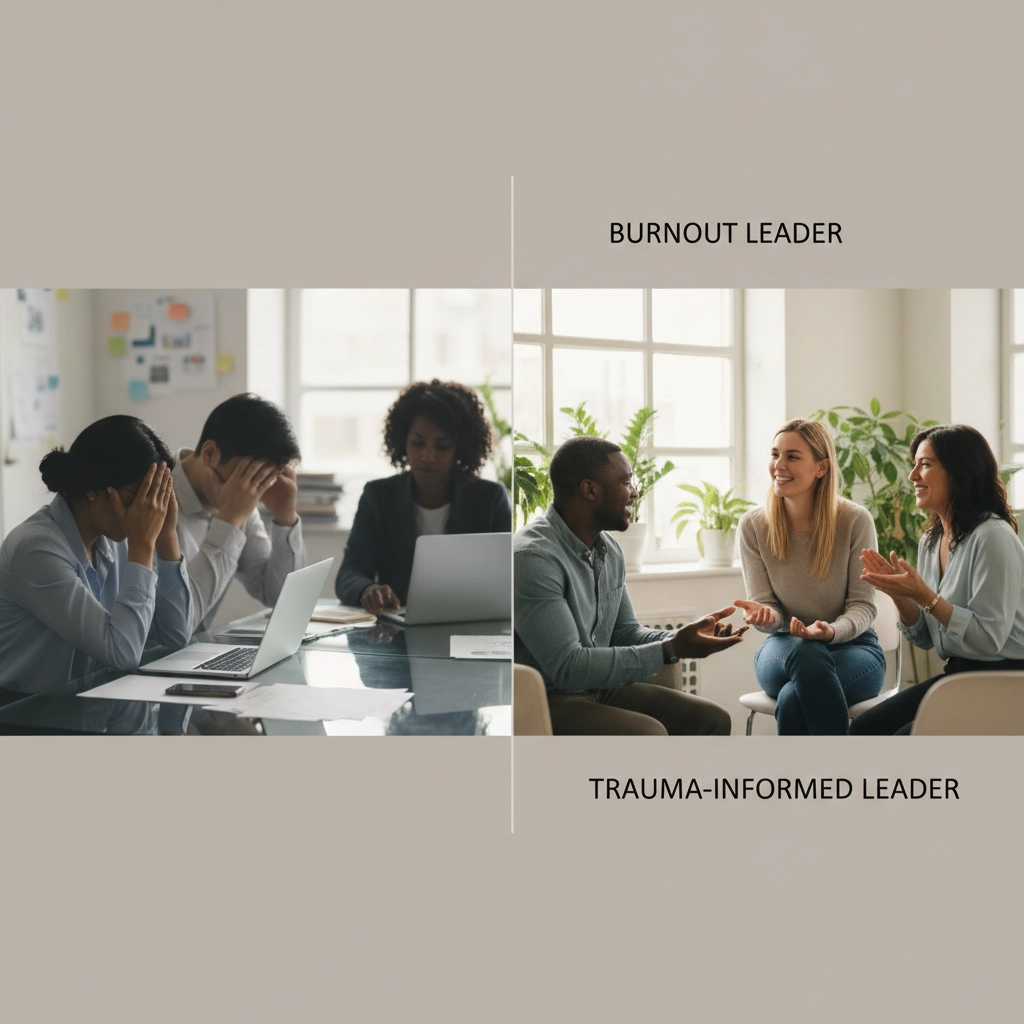
Trauma-informed leadership isn't about becoming a therapist. It's about creating environments where people feel safe enough to do their best work. It means understanding that past experiences shape present behaviors and responding with curiosity instead of judgment.
A trauma-informed leader recognizes that the employee who seems "resistant to change" might be protecting themselves from situations that feel chaotic or unpredictable. Instead of pushing harder, they create more structure and communicate changes well in advance.
They understand that the team member who doesn't speak up in meetings might not be disengaged – they might have learned early that their voice doesn't matter. So they find alternative ways for that person to contribute.

These leaders create psychological safety not through team-building exercises, but through consistent, predictable responses that help their team members' nervous systems settle down enough to access their higher-level thinking.
When trauma-informed leadership practices are implemented, the results are impressive. Organizations see increased employee retention, improved interpersonal cohesion, and enhanced organizational responsiveness. Program data shows that 80% of employees retain their jobs after six months when trauma-informed management approaches are used.
Five Steps to Close the Gap in Your Organization
1. Start With Self-Awareness
You can't lead others through territory you haven't mapped yourself. Take an honest look at your own stress responses, triggers, and coping mechanisms. When do you react versus respond? What situations make you feel threatened or defensive?
2. Learn to Recognize Trauma Responses
Trauma doesn't always look like what you see in movies. It can show up as perfectionism, people-pleasing, avoidance, aggression, or seeming indifference. Train yourself to see these as adaptive responses rather than character flaws.
3. Shift Your Language
Instead of asking "What's wrong with this person?" start asking "What happened to this person?" This simple reframe changes everything about how you approach challenging behaviors.
4. Create Predictable Structures
Trauma thrives in chaos and uncertainty. Build regular check-ins, clear communication protocols, and consistent feedback loops. When people know what to expect, their nervous systems can relax enough to focus on work.
5. Invest in Proper Training
This isn't something you can learn from a weekend workshop or a single article. Trauma-informed leadership requires ongoing education, practice, and support. Make it a priority in your professional development budget.
The Bottom Line for Burnt-Out Leaders
You're already dealing with enough. The last thing you need is another leadership fad or complex framework to implement. But here's the thing: trauma-informed leadership actually makes your job easier, not harder.
When you understand what's really driving your team's behaviors, you stop wasting energy on ineffective solutions. You stop taking things personally. You start seeing patterns instead of problems.
Your burnt-out, overwhelmed team members aren't broken – they're human beings doing the best they can with the tools they have. When you give them better tools and create safer environments, they don't just perform better – they thrive.
The 90% of leaders who aren't trauma-informed aren't bad leaders. They're operating with incomplete information in a world that's more complex than the leadership models they learned. But the leaders who close this gap? They're the ones building the workplaces where people actually want to show up.

The question isn't whether your team has experienced trauma – statistics tell us they have. The question is whether you're going to be part of the solution or continue contributing to the problem.
The cost of staying where you are is measured in turnover, burnout, conflicts, and lost potential. The investment in becoming trauma-informed? It pays dividends in engagement, retention, innovation, and results.
Your team is waiting for a leader who gets it. The only question left is: when will that be you?
Ready to bridge the gap? Explore trauma-informed leadership resources and discover how this approach can transform your team's performance and your own leadership effectiveness.